Sunday, 3 March 2013

Children´s projects

This is now going back several days - due to technical delays now resolved as I have the use of Aurora´s computer.


This was on our second morning here when we visited a primary school called El Platanal. It is in a rural area a few km from León and there was an issue with children being kept from school to work in the fields. The authorities are aware of this issue and support such projects, but don´t have the resources we are used to in Europe. A group in Oxford called BOAT fund a breakfast club here. Feeding the children encourages the families to send them to school and there is a rota for the mothers (but not the fathers) to prepare the food.
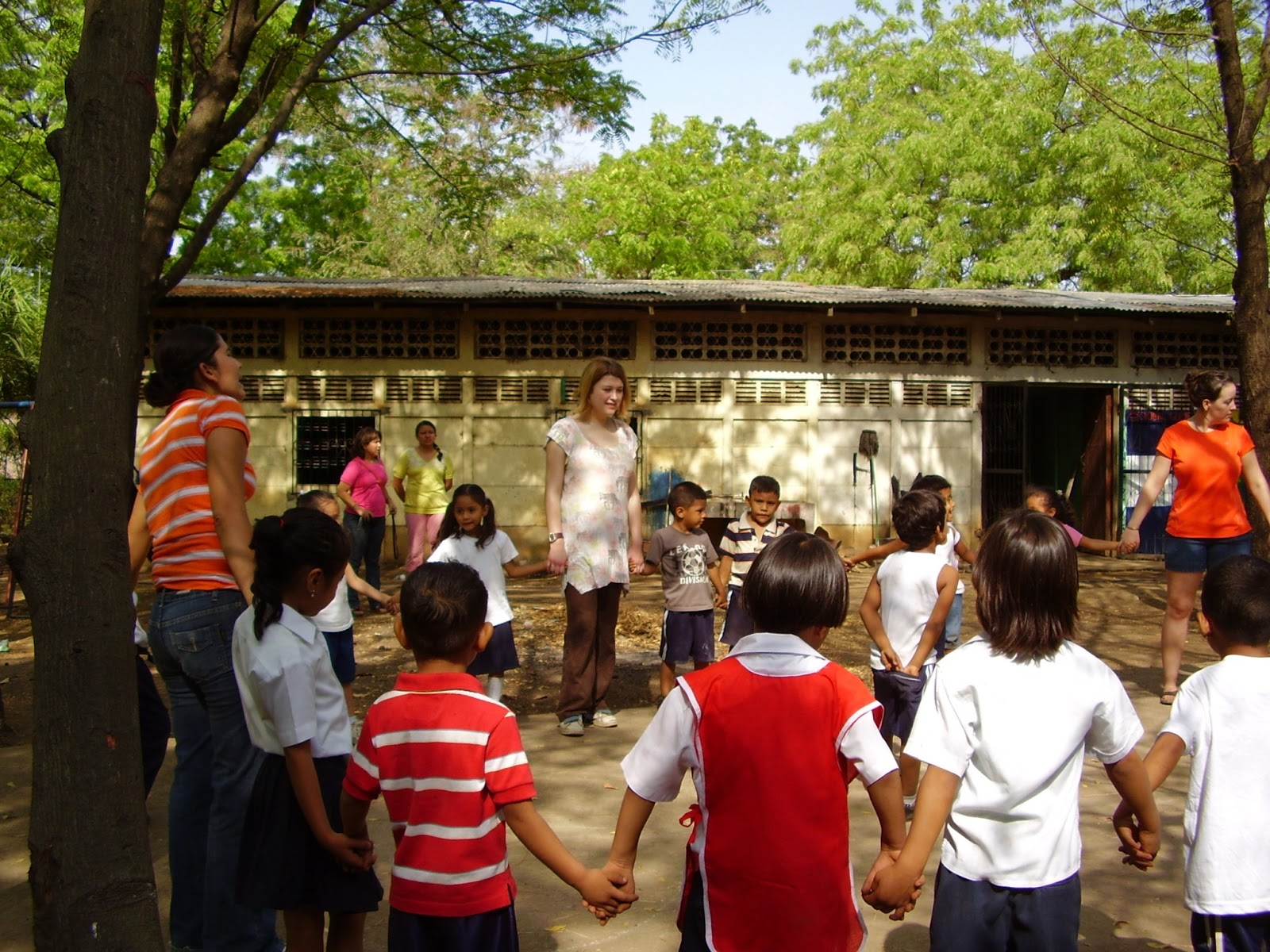
Next we went to a nursery school in León called Los Ositos (the teddy bears). We have sent funds for equipment here. Jo and Pete (he´s out of shot but was there- honest) joined in the games.


This is a play park in the city, called La Juegoteca and it felt like an oasis of cool. The council have donated the land and a group of p/t workers and volunteers run it as a play centre and sort of after school club. Families have to bring plastic bottles for recycling which are then sold to help fund it. They don´t allow litter and are teaching the children about keeping the area tidy and taking pride in their city. They encourage educational play and have a toy gun amnesty, where children can exchange violent toys for educational ones. The irony is that one mother told me that her son begged for a water pistol so he could exchange it for a toy here. An example of unforseen consequences. It was a lovely place with a small waterfall and an enclosure with tortoises.
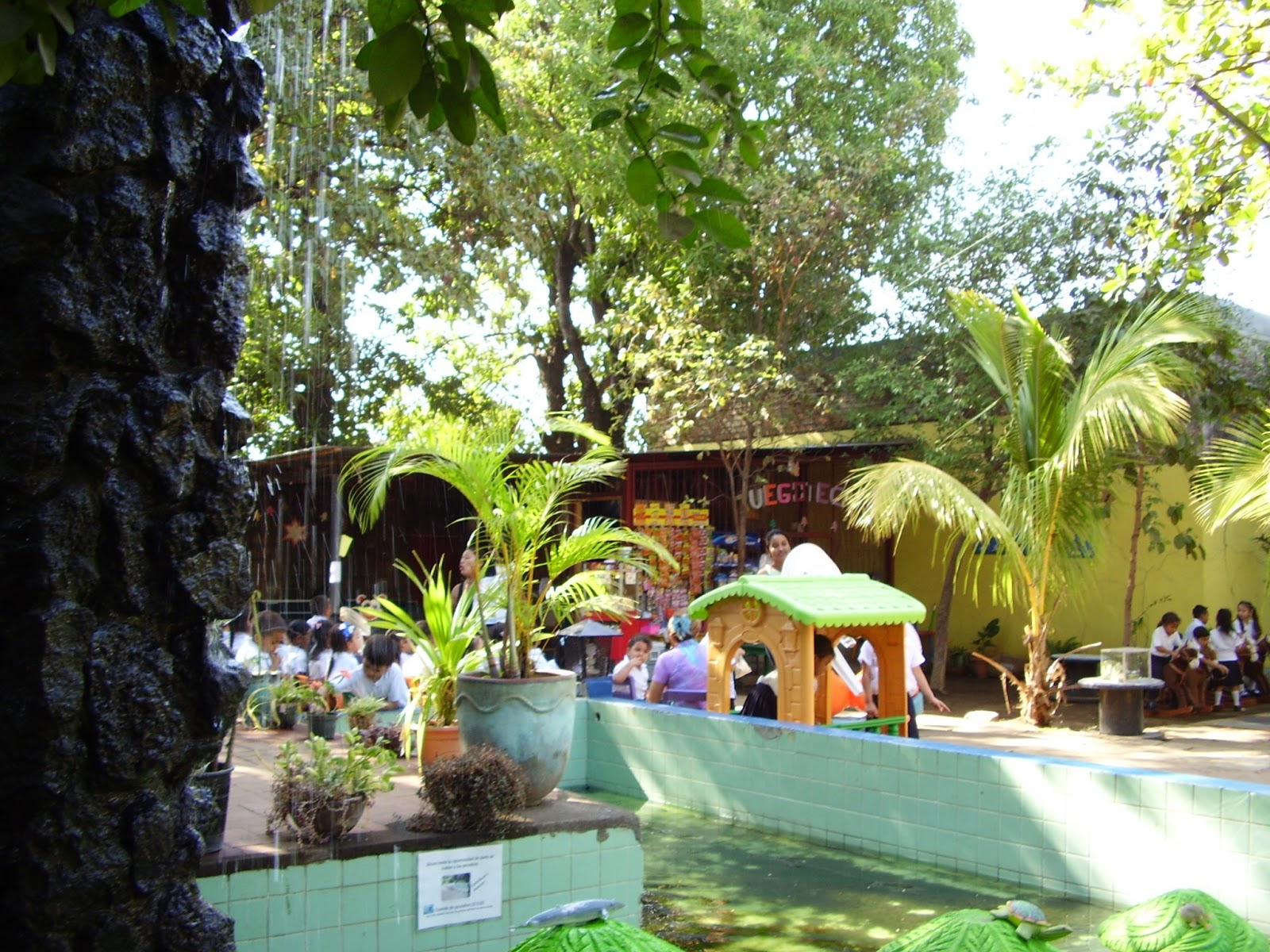

Another view of La Juegoteca.


Children doing a traditional dance, which is telling some sort of story or legend but I don´t know what. This is in the NECAT centre. NECAT is another NGO with Oxford links and the centre is a sort of after school club with a library and travelling teaching resource. It is part-funded by a shop at the front, but we had such a tight schedule there was no time to buy anything so I hope to return this week. The children put on quite a show for us.


This is a "gigantona" dancing as part of the show the children had prepared for us. A gigantona, or giant woman puppet, is an important part of Nicaraguan culture and she is carried by someone under the skirts and bought out at fiestas. We have one in Oxford, which was brought over in 2008 by visitors from León as a gift to the people of Oxford. We, in the Oxford León Assn, think it should be displayed in the Town Hall. If you agree, and live in Oxford, please write to your city councillor.


One of NECAT´s projects is this mobile teaching resource that is taken to primary schools in the city. It's a tricycle with a big box of tricks. The young man´s T-shirt says "we are the sons of the revolution and history". He is a student volunteer with this project.


The lesson was about volcanoes and they had models of local ones. Using baking powder, sparklers and other things they put on a show but sadly I didn´t catch the full eruption. The children liked it and afterwards we were introduced and they asked us questions. I explained that we came from another country far away. "¿Like Costa Rica or Honduras?" Trying to tell then about England and Sweden was beyond their comprehension so I talked about cold and snow. One of the ladies from Lund in Sweden was there too. It is also twinned with León and our delegations overlapped.


Saturday, 2 March 2013

Farewell drinks


John, Mike and ¨Pete on their final evening in Nicaragua, forcing down some beer,


This was our view. Note that the sand is black and not white or golden. This is because this area is volcanic.


The waves were huge and it is a surfing coast, with very few people as tourism is still underdeveloped.

On the farm

So I´m now staying with doctors Aurora and Andrés. Andrés explained he has a small farm/piece of land. It´s full of indigenous trees and is all organic. He likes to go there on Saturdays and exchange his surgeon´s scalpel for a machete. We saw the following trees; mango, coffee (the beans taste fruity), bamboo, cedar (very weedy looking), banana and plantain and others...


He´s holding a cashew and cut it very neatly. The nut grows at the bottom of the fruit that he´s about to cut. I then sucked the fruit, which is sort of like mango but with a distinctive flavour. The juices stain, so I had to lean forward in a most inelegant way and still got messy. Good thing I had some wet wipes... Andrés gave me the nut to take home and plant.


Had I known when I got dressed this morning that I would be picking cashews, I would have worn a top that didn´t clash. But who could have forseen this?


A chocolate tree. How could I not be happy here?


This is what the cocoa looks like. There are lots of seeds, each about the size of a broad bean. I sucked one and it tasted fruity, quite like lychee. The inner bit is dried and then cracked open to remove the seed. They use it to make some sort of drink. I supect it´s not like Cadbury´s drinking chocolate - which is unthinkable in this heat. The ones we sucked have been planted in a small bed at home and once they start to grow as trees, they´ll be planted in the wood.


This is the cocoa, growing directly on the trunk of the tree and it comes from those tiny wee flowers.


Andres´ son "fishing" for mangoes with a net on the end of that pole.


Comfort


This is the patio of the hotel. Somewhat ironic that it´s called "Posado del Doctor" (the doctor´s place) given that I´ve moved to a doctor's place. My room was tucked in the right hand corner and the photo taken from the shady veranda where we could relax on rocking chairs. Not bad, eh?


The sun setting into the Pacific. You can´t see the pelicans but they really were there.

And then there was one


The others have flown away now back over the Atlantic to fresher climates, so that's the end of the official delegation from Oxford, but I still have lots to do in terms of people to meet with and projects to visit. It would also be nice to see a few more sights, perhaps usual tourist destinations, such as museums and the ruins of Old Leon. John and Mike visited the Sandanista Museum which has reports and photos of Leon during the civil war.

I have now moved from the hotel and am staying with a friend of Jane Mercer, our long-term volunteer. Aurora is a doctor who teaches at the Medical School here and studied in Lund, Sweden. She spent time in Oxford learning English before doing her doctorate in Sweden, so she is very international. In the back yard of her house are trees: papaya, mango, lime, cocoa and cinammon so it´s all very exotic. A papaya is ripening and should be ripe tomorrow. How exciting is that? On arrival I was given a bowl of fresh fruit salad of exotic fruits which was wonderful.

Yesterday evening Jo went back to the mountains with the beekeepers to harvest the honey, being a brave and adventurous youngster. The rest of us returned to the coast where we sat in a lovely outdoor cafe, watched the huge breakers coming in and the boats and the pelicans and sipped our drinks and ate fish. That seemed a far better option than a bumpy drive up the volcano, putting on a bee suit (even after dark and up the mountain, it´s still very hot) and collecting honey. For some reason this has to be done after dark. Maybe because the bees are less agressive? They are africanised bees. I´m no expert but gather this means that they´re well 'ard and should not be messed with. It suits me fine not to mess with them. But if the exporting gets under way I may well be selling you some "Nica Nectar".

I realise I have mentioned Andrew and Jane without any explanation. They are from Oxford and set up a charity called Nuevas Esperanzas which now has a staff of 15. They work in rural communities and as Andrew is a water engineer, many of their projects focus on clean water supplies. It is appropriate to fund water-related projects with funds raised from our sponsored swim and Andrew has given talks when back in Oxford. The big excursion on Wednesday was seeing at first hand some of their projects, including the bees, where they train local people in bee-keeping (as a way of diversifying)- I have been learning lots from them.
and they have been hugely helpful in looking after us, advising and answering all our questions. 

The Oxford Leon Assn funds other projects in Leon and we have been visiting some of these and I´m meeting people running others and will report back to our committee.
Will try to add some more photos now.
Jan


Friday, 1 March 2013

Getting acclimatised

At last I'm able to log on and hope to download some photos at last. Various boring technical problems, so posts so far have been via email to Tim.

It is another world here and for all that we read of hear of the poverty and the heat, nothing quite prepared me for actually being here. It's Friday morning here and the others in the delegation are returning to Oxford tomorrow. I'll move out of the hotel and will stay for a few days with a doctor called Aurora. She spent some time in Oxford a few years ago and stayed with Jane Mercer and has kindly offered me her spare room.

So far this morning I visited the covered market of León, which is sort of like ours but with some very strange-looking fruit and veg. I then went to the cathedral and climbed to the roof. Obviously, being the sort of person who often climbs church towers... (how many have fallen off chairs reading this?).

Yesterday I met with some Biologists in the Entomological Museum. Once they got over their disappointment that I'm not a fellow Biologist, but a mere messenger, it was very encouraging to speak about co-operation across the continents in scientific research. I love the idea of students from Oxford coming to do field work here - as long as I don't have to crawl on jungle floors looking at bugs.
In the Museum of Entomolgy
Another mtg was with a retired psychologist from Seattle who, with her Medic partner, spends 5 months per year running a small NGO. One of the things they do is run first aid training for teachers, bus drivers and all sorts of other groups. I hope to visit some of their projects next week.

We were also taken to the lovely Botanical Gardens outside of the city.


My big tale really is Wednesday, when we went "out in the field" with Nuevas Esperanzas. I sent a summary yesterday although hadn't explained clearly that the long pipeline that they are building to take water down the mountain is because the water up the mountain is absolutley pure with no arsenic, so that intention is that this will be the drinking water for the communities on the plain - there is a limited supply. They will use the water with arsenic for washing: it is only poisonous when ingested. This is the compromise solution that seems safest for the people.

Now, at last, some photos:


A well highly contaminated with arsenic on the plain below Volcano Telica


The clean water that will be piped down the volcano to the plain. This is a huge project and will involve building suspention bridges to take the pipes down the canyon to the community 4km below.


Working hard! The local people in the background were discussing forming a co-operative for their beekeeping. This is a project set up by Nuevas Esperazas to encourage diversity and they hope to export the honey to the UK.
 
 Meanwhile Jo, Mike and John visited the bees themselves...


Cllr John Tanner and Mike Rowley prepare to meet the bees.


Hot water spring on the volcano


A rainwater collection tank


View of a volcano from the back of the pick-up

Street scene in León

Making breakfast in the kitchen of a primary school, with funds from another Oxford organisation. (This is was a different day.)


Children eating their breakfast in El Platanal Primary school. The menu was tortilla, beans and rice and a cereal drink. Note the water tower - base made of asbestos...


Thursday 28th February, 7pm
Wednesday was a big day with Nuevas Esperanzas, an organisation whose projects  we have helped to fund from Oxford.

We set off at 7am to go to the mountains in the Nuevas Esperanzas four wheel drive, pick-up truck. Someone had to travel in the back and for the first stretch it was me!
Andrew has an interesting use of the word "road". He told us they had built roads to reach some of the remote villages. For "road" read "rough, stony, bumpy bridle way”. I was worried about riding a horse but can see they would be the best form of transport here. Even with the potholes of Oxford we cannot imagine driving up a rough stony track.

It was not a smooth ride at all, but it was far too hot to get out and walk. Especially for a wuss like me. Can you believe, when it comes to climbing volcanoes, four wheel drives are even more useful than they are in north Oxford.

We visited lots of NE projects, mostly to do with water supply - tanks to collect rainwater, storage units by fresh springs. We also went to the area contaminated by arsenic and watched as Leo, one of Andrew's employees, analysed the levels of arsenic. Very sad. The WHO standard is 10 parts per billion and we witnessed levels of 35, 50 and over 200.

I did walk, or maybe scrambled is a better description, down to see the spring where they have built a storage tank. Andrew was much kinder than my brothers ever were in helping me down the hard bits. So the earth was dry, black, sandy and very dusty and it was hot. Very Hot. The team are building a pipeline to carry the fresh, filtered water, with the arsenic removed, down to the villages on the plain some km below.

We also went to one of the apiaries that they have set up. John, Mike and Jo all donned the full suits and went to handle bees. Pete and I wimped out and sat with the locals in a veranda and had a go on the hammock. Yes people really do use hammocks!

Rural poverty is something else. It is shocking to see the very basic shacks that serve as houses here. But then I suppose if you live on the side of a volcano, you wouldn’t build a strong brick house!
 
There is lots more to say but we really must go…..